
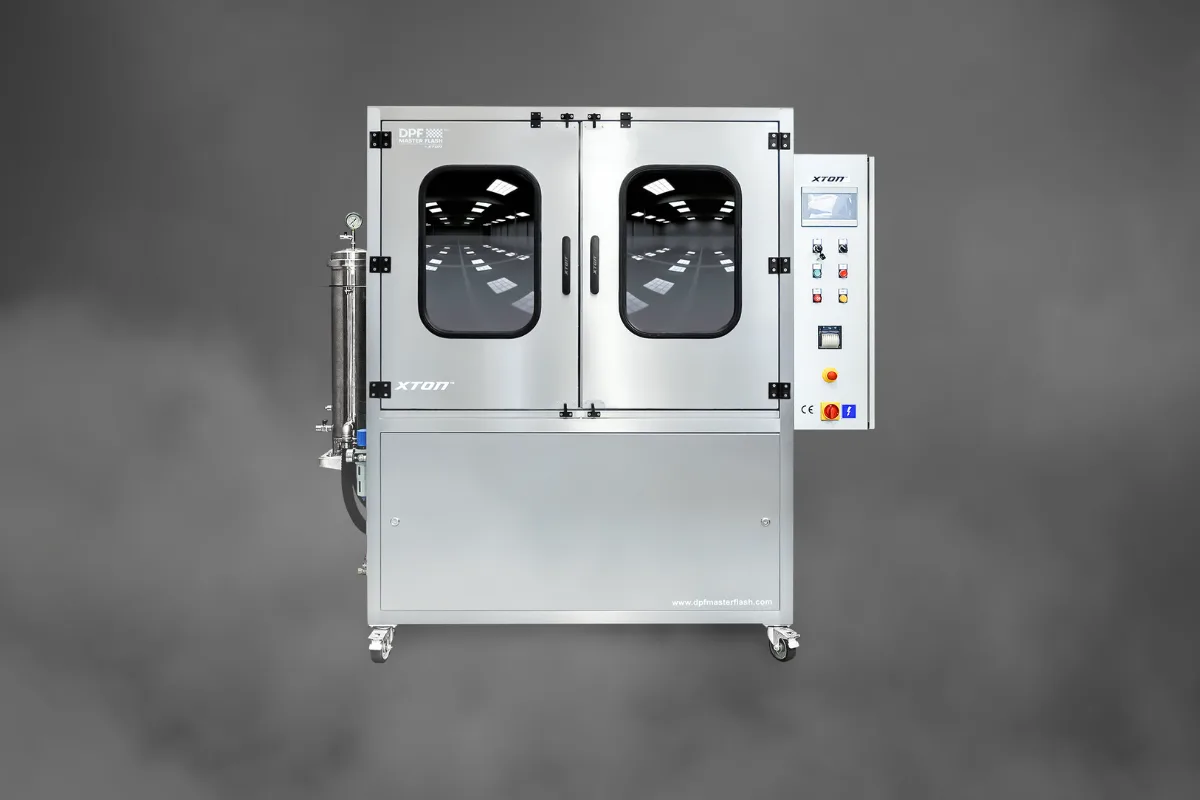
What does the particulate filter cleaning process look like?
During cleaning, the DPF Master Flash™ machine forces water and air into the particulate filter under pressure. The forces acting on the water create turbulent flow, in which the liquid particles move along irregular, often circular paths, constantly colliding and mixing.
The second phenomenon at work during cleaning is cavitation: the sudden change of the liquid into vapour as a result of pressure differences. Together, these effects let the liquid flow through the narrow, clogged channels of the filter and remove deposits, even those lodged in the micropores of the channel walls.
Thermal (oven) cleaning exposes the ceramic filter core to very high temperatures, and soaking the filter in aggressive chemicals can also attack the ceramic. The hydrodynamic method cleans the filter thoroughly without either of these stresses on its ceramic structure.
To make cleaning more effective, we use the active cleaning agent DPF Cleaner Extra Power, whose formula softens deposits of soot, ash, dust and other contaminants, binds to the dirt particles and makes them easier to wash out.
The cleaning process with a DPF Master Flash™ machine
- Connecting the filter to the machine.
- Permeability (back-pressure) test.
- Disconnecting the filter from the machine.
- Applying the XTON® DPF Cleaner Extra Power agent.
- Reconnecting the filter to the machine.
- Starting the cleaning process.
- Drying.
- Final back-pressure test.
- Printing the filter’s test results.
Advantages of the machine
- CE marking: the machine carries CE marking, confirming its conformity with the applicable EU directives and standards, and is made by an ISO-certified manufacturer.
- Ease of use: the ergonomic design and intuitive interface make it simple to operate without specialist knowledge.
- Design: high build quality and attention to detail make XTON® equipment stand out from the competition.
- Cleaner process: the hydrodynamic process runs in a closed liquid circuit, with no open flames or aggressive solvents.
- All in one: integrated hot-air drying and filter cooling, plus permeability measurement and printing of the results.
- Low running costs: just a few pounds or euros per filter in consumables.
- Up to 99% efficiency: effective removal of soot, cerium oxide, oil deposits and heavy metals from the particulate filter.
- Connectivity: the Ethernet controller enables remote diagnostics and software updates, and the mobile app lets you monitor the machine from your phone.
- Personalisation: the results printout can be customised with the workshop’s details or the vehicle model.