
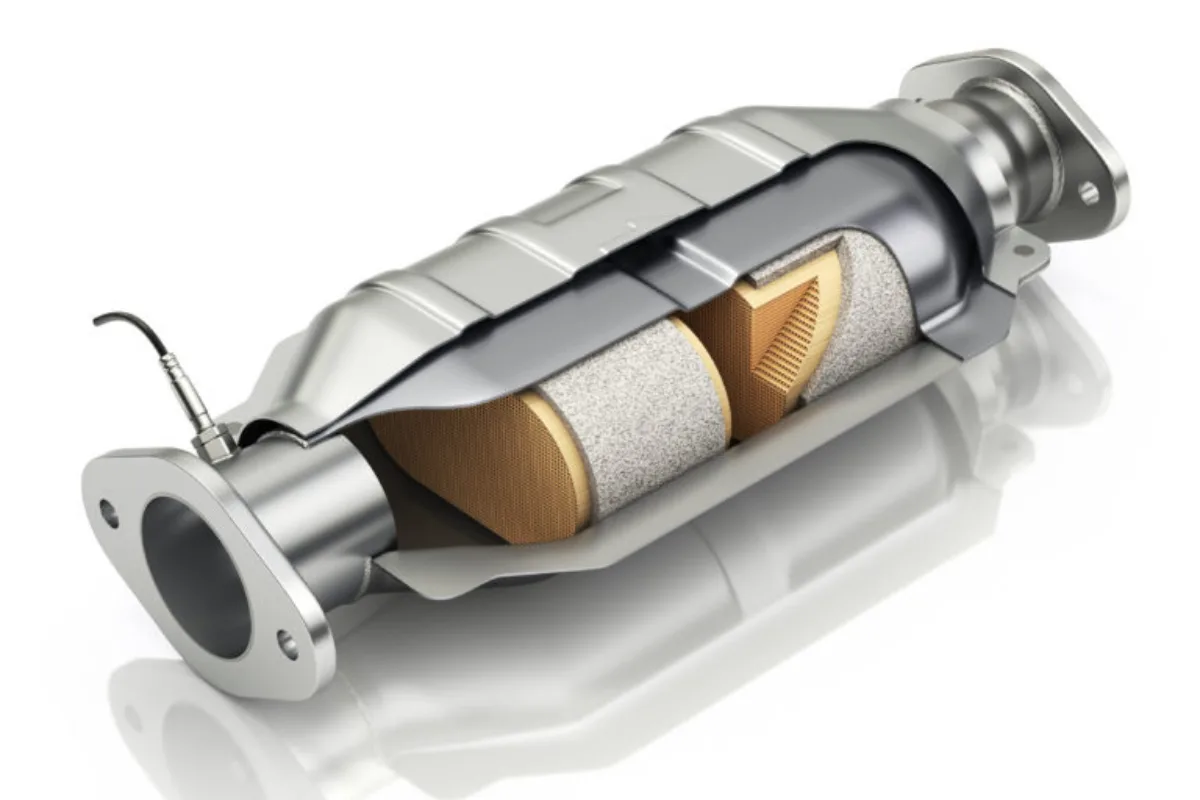
The diesel particulate filter (DPF) is considered one of the most troublesome components of modern diesel cars. It is complex and it is expensive. How is a DPF built? How should you drive a car with a DPF to avoid breakdowns? And how do you stop it from clogging?
The first particulate filters appeared in diesel cars as early as the 1980s, to get rid of the typical black smoke from the exhaust pipe. Back then they were rare. No diesel engine can mix and burn its fuel and air completely. The leftovers form soot: solid particles made up of carbon, hydrocarbons, sulphates, sulphur oxides, metals and water.
Euro 4 (2005–2006) halved the permitted particulate emissions of diesel cars from 0.05 g/km (Euro 3) to 0.025 g/km, and Euro 5 (2009–2011) cut them to just 0.005 g/km — a level that, in practice, only a particulate filter can achieve. Car manufacturers therefore returned to a solution they already knew, and the particulate filter became standard equipment on diesel cars.
The technology developed in two directions: most manufacturers used standard (“dry”) DPFs, while the French manufacturers (Renault, Peugeot, Citroën) introduced FAP filters, known as ‘wet’ filters because they work with a fuel-borne additive that helps the soot burn off.
How is a DPF built?
The DPF is part of the exhaust system and sits behind the catalytic converter. It looks much like a catalytic converter: a round or flattened metal housing. It is controlled by the engine control unit (ECU), which reads the pressure and temperature sensors located before and after the filter.
Inside the metal housing there is a ceramic core made of parallel channels that are blocked at alternate ends: the inlet channels are closed at the exhaust-pipe end and the outlet channels at the engine end. The exhaust gas has to pass through the porous channel walls (hence the term wall flow), which trap the soot particles.
Is a DPF really maintenance-free?
In theory, a DPF should not need any maintenance. The exhaust gas flows through the channels and the solid particles are trapped on the walls. These particles should burn off during normal driving, when the exhaust temperature reaches 400–600 °C. If the filter starts to clog, the car should deal with it through active regeneration: extra fuel is injected to raise the exhaust temperature and burn off the soot.
In practice, however, this does not always work perfectly. For the filter to work properly, the engine must be in good condition. Problems such as oil leaks, worn seals or faulty injectors make the filter clog faster.
Some manufacturers tried to solve the problem by making the system more complex, for example with a dedicated fuel injector in the exhaust to aid regeneration. This extended the filter’s service life, but it did not stop clogging altogether, and these filters turned out to be considerably more expensive.
Conclusion
Although the DPF is designed to be maintenance-free, whether it keeps working properly depends on good engine maintenance, the right engine oil and suitable driving. Otherwise, a clogged filter can lead to costly repairs.